
etapidi is a unique PD-1 inhibitor, optimally designed for potent PD-1 binding and more robust T-cell activation1-3
See what makes etapidi different in this short video:
Clinical significance of preclinical data has not been established. No head-to-head clinical trials between products have been performed.
In preclinical models, etapidi demonstrated potent PD-1 binding for a near total blockade of PD-L11
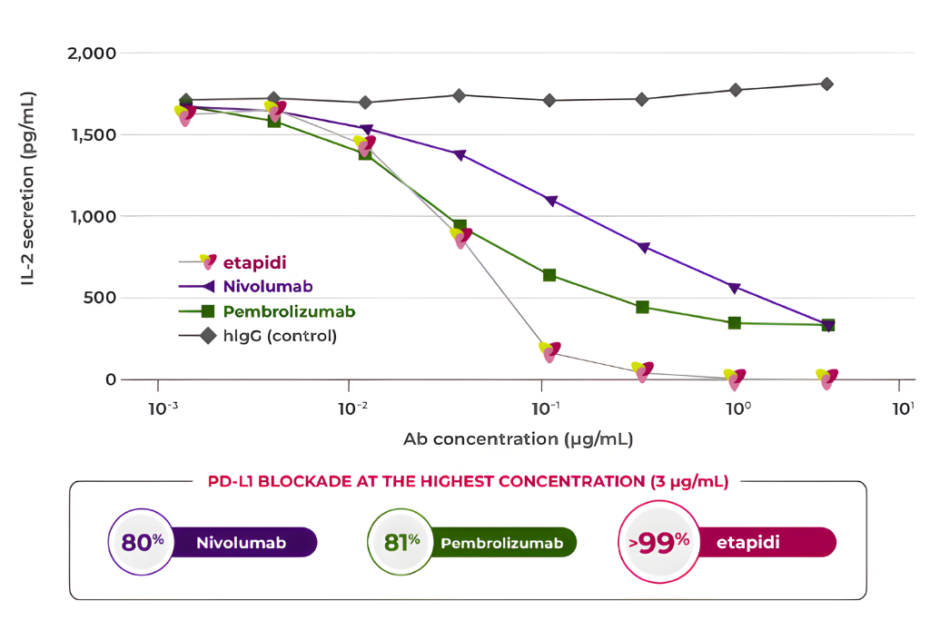
In preclinical models, etapidi demonstrated robust T-cell activation2-3
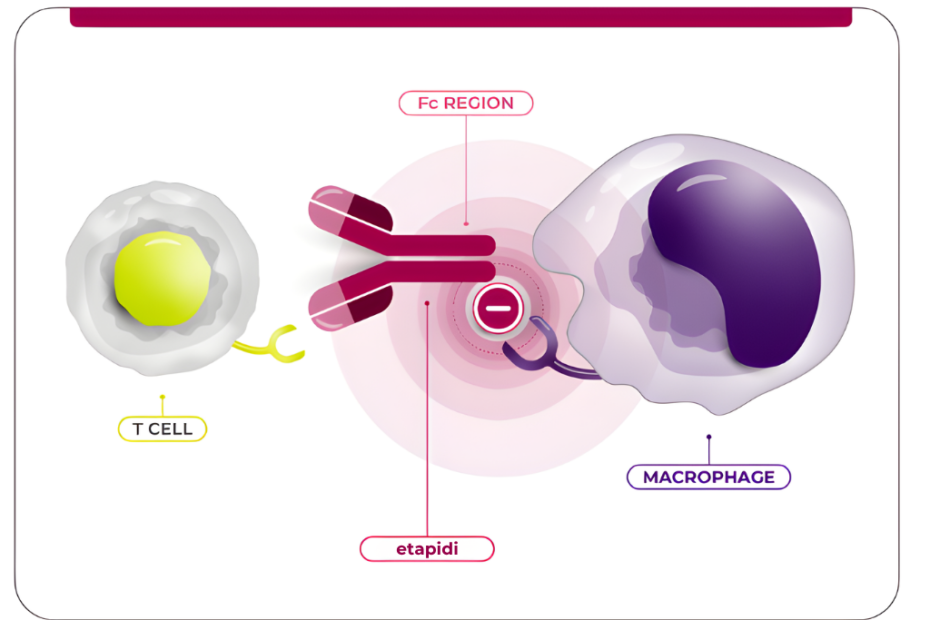
etapidi was specifically engineered to increase the number of activated T cells by preventing its binding to FcγR on macrophages, thereby preventing T-cell clearance. Other PD-1 inhibitors, such as nivolumab and pembrolizumab, can easily bind to the FcyR.
T-cell depletion may be especially relevant in the macrophage-rich environment of the peritoneum.
Clinical significance of preclinical data has not been established. No head-to-head clinical trials between products have been performed.
DISCOVER THE DATA ACROSS ALL INDICATIONS
Proven mPFS in Patient with 1L Squamous NSCLC AND PD-L1 SCORES ≥ 1%
Proven mPFS in Patient with 1L Non-Squamous NSCLC AND PD-L1 SCORES ≥ 1%
Proven mPFS in Patient with 2L NSCLC AND PD-L1 SCORES ≥ 1%
Unprecedented OS in patient with 1L escc and pd-L1 Scores ≥ 1%
Proven OS in Patient with 2L ESCC AND PD-L1 SCORES ≥ 1%
Proven OS in Patient with 1L GC/GEJC AND PD-L1 SCORES ≥ 1%
DISCOVER THE DATA ACROSS ALL INDICATIONS
Proven mPFS in Patient with 1L Squamous NSCLC AND PD-L1 SCORES ≥ 1%
Proven mPFS in Patient with 1L Non-Squamous NSCLC AND PD-L1 SCORES ≥ 1%
Proven mPFS in Patient with 2L NSCLC AND PD-L1 SCORES ≥ 1%
Unprecedented OS in patient with 1L escc and pd-L1 Scores ≥ 1%
Proven OS in Patient with 2L ESCC AND PD-L1 SCORES ≥ 1%
Proven OS in Patient with 1L GC/GEJC AND PD-L1 SCORES ≥ 1%
1L, first line; Ab, antibody; ESCC, esophageal squamous cell carcinoma; Fc, crytallizable fragment; FcγR, Fc gamma receptor; GC, gastric cancer; GEJC, gastroesophageal junction cancer; GI, gastrointestinal; hIgG, human immunoglobulin G; IL-2, interleukin-2; PD-1, programmed death receptor 1; PD-L1, programmed death ligand 1.
References:
- Hong Y, Feng Y, Sun H, et al. FEBS Open Bio. 2021;11(3):782-792. doi:10.1002/2211-5463.13102
- Zhang T, Song X, Xu L, et al. Cancer Immunol Immunother. 2018;67(7):1079-1090. doi:10.1007/s00262-018-2160-x
- Zhang L, Geng Z, Hao B, Geng Q. Cancer Control. 2022;29:10732748221111296. doi (7)10.1177/10732748221111296